

The Digital Language Revolution: How Acronyms Changed Our Communication
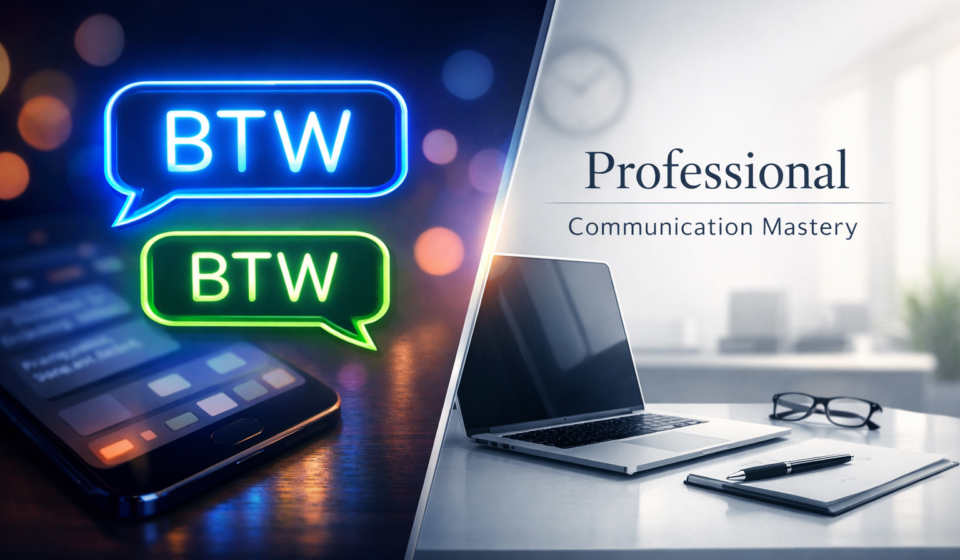
In the rapidly evolving landscape of digital communication, language has undergone a fascinating transformation. What began as simple shortcuts to save time on early mobile keyboards has blossomed into a complex ecosystem of digital shorthand that shapes how we connect in the 21st century. Among these linguistic innovations, text acronyms like BTW have become ubiquitous elements of our daily exchanges, transcending platforms from casual SMS messages to professional emails and beyond.
Table Of Content
- The Digital Language Revolution: How Acronyms Changed Our Communication
- What Does ‘BTW’ Mean in Text? Definition and Examples
- When Should You Use ‘BTW’? Context Matters
- Suitable Contexts for Using BTW
- Unsuitable Contexts for Using BTW
- The Nuance of Tone: How ‘BTW’ Can Be Misunderstood
- Tone Considerations
- Timing Analysis
- Polite, Professional, and Casual Alternatives to ‘BTW’
- Professional Alternatives
- Polite Semi-Formal Alternatives
- Casual Alternatives
- Choosing the Right Alternative Based on Context
- The Evolution of ‘BTW’ in Digital Language
- Real-World Examples: 13 Ways to Say ‘BTW’ With Style
- Summary: Mastering ‘BTW’ Means Mastering Communication Transitions
- Key Takeaways
This evolution represents more than mere convenience—it reflects fundamental shifts in how we prioritize information, manage attention, and signal social belonging in digital spaces. Understanding these nuances isn’t just about staying current with trends; it’s about mastering the subtle art of effective communication in an increasingly text-based world.
What Does ‘BTW’ Mean in Text? Definition and Examples
BTW stands for “By The Way,” a transitional phrase used to introduce information that’s supplementary, tangential, or an afterthought to the main conversation. In text form, this acronym serves as a digital bridge between topics or a signal that additional information is forthcoming.
“The meeting is scheduled for 3 PM tomorrow. BTW, the CEO might join us, so come prepared with your quarterly reports.”
This three-letter combination performs a specific conversational function: it allows the communicator to add information that might not be central to the main message but is still worth mentioning. It’s essentially the digital equivalent of a conversational pivot or an aside.
The acronym originated in early internet chatrooms and SMS messages when character limits and slow typing speeds made brevity necessary. Today, it has become so commonplace that many users deploy it without conscious thought about its conversational implications.
When Should You Use ‘BTW’? Context Matters
While BTW has secured its place in digital lexicon, understanding when it’s appropriate to use can be the difference between coming across as relatable or unprofessional. Context is everything in digital communication.
Suitable Contexts for Using BTW:
- Casual conversations with friends, family, and close colleagues
- Personal social media posts and comments
- Informal team chats on platforms like Slack or Microsoft Teams
- Quick, informal emails between well-acquainted colleagues
- Text messages and direct messages on social platforms
Unsuitable Contexts for Using BTW:
- Formal business proposals or contracts
- Initial communications with new clients or business partners
- Academic or scholarly writing
- Public-facing corporate communications
- Legal or medical documentation
- Job applications and professional correspondence with potential employers
The key consideration should always be your relationship with the recipient and the nature of the communication. When in doubt, err on the side of formality, especially in professional contexts where clarity and precision matter most.
The Nuance of Tone: How ‘BTW’ Can Be Misunderstood
Despite its seemingly straightforward meaning, BTW carries subtle tonal implications that can sometimes lead to miscommunication. The acronym’s casual nature can affect how your message is perceived in ways you might not intend.
Tone Considerations:
Dismissiveness: Using BTW can sometimes make important information seem like an afterthought, potentially diminishing its perceived importance.
“We’ll discuss marketing strategies at tomorrow’s meeting. BTW, sales dropped 15% this quarter.”
In this example, significant information that might warrant its own focused discussion is potentially undermined by being introduced with BTW.
Abruptness: When used to change topics suddenly, BTW can come across as disjointed or even rude, especially in professional settings.
Passive-aggressiveness: In certain contexts, BTW can be perceived as a way to slip in criticism or uncomfortable information indirectly.
“Thanks for the presentation yesterday. BTW, you might want to check your data sources next time.”
Timing Analysis:
The placement of BTW within a message also matters. When used at the beginning of a conversation, it can feel jarring. When used at the end, it might seem like you’re adding information you initially forgot or deemed unimportant. The most natural placement is typically mid-conversation when transitioning between related topics.
Polite, Professional, and Casual Alternatives to ‘BTW’
Having a repertoire of alternatives to BTW allows you to adjust your communication style to match different contexts and relationships. Here’s a comprehensive list of alternatives categorized by formality level:
Professional Alternatives:
- Additionally – “Additionally, we should consider market trends from Q3.”
- Furthermore – “Furthermore, the client has requested a follow-up meeting.”
- Moreover – “Moreover, these findings suggest a shift in consumer behavior.”
- I should mention – “I should mention that the deadline has been extended.”
- It’s worth noting – “It’s worth noting that similar projects have faced regulatory challenges.”
Polite Semi-Formal Alternatives:
- Incidentally – “Incidentally, I met with the design team yesterday.”
- On a related note – “On a related note, we’ve updated the project timeline.”
- While we’re on the subject – “While we’re on the subject, have you reviewed the latest analytics?”
- Before I forget – “Before I forget, the conference room has been reserved for Tuesday.”
Casual Alternatives:
- Also – “Also, I found this article you might like.”
- Oh, and – “Oh, and don’t forget to bring your laptop tomorrow.”
- Just so you know – “Just so you know, the meeting time changed to 2 PM.”
- FYI – “FYI, the printer on the third floor is working again.”
- Heads up – “Heads up, there’s construction on the main route to the office.”
Choosing the Right Alternative Based on Context
Selecting the appropriate alternative to BTW requires understanding the communication context. This comparison table highlights different scenarios and the most suitable alternatives:
| Communication Scenario | Best Alternative | Why It Works |
|---|---|---|
| Email to senior management | Additionally / Furthermore | Maintains professional tone and clearly signals supplementary information |
| Client proposal document | It’s worth noting / Moreover | Conveys thoughtful consideration rather than a casual afterthought |
| Team Slack channel | Also / Just so you know | Strikes the right balance between casual and clear in team settings |
| Customer service email | I should mention / On a related note | Polite but straightforward; adds information without seeming too formal or casual |
| Message to close colleague | Oh, and / Heads up | Reflects familiar relationship while still conveying information clearly |
The Evolution of ‘BTW’ in Digital Language
The journey of BTW from niche internet slang to mainstream communication tool reflects broader patterns in digital language evolution. Understanding this history provides context for its current usage and cultural significance.
In the early 1990s, as internet chat rooms and bulletin board systems gained popularity, character and bandwidth limitations encouraged users to develop shorthand expressions. BTW emerged alongside other now-familiar acronyms like LOL, TTYL, and BRB. These early adopters were essentially creating a new dialect optimized for the constraints of early digital platforms.
By the early 2000s, with the proliferation of mobile phones and SMS messaging, these acronyms moved from computer screens to mobile devices. The 160-character limit of early text messages further cemented the utility of BTW and similar shorthand.
The smartphone revolution beginning around 2007 paradoxically both challenged and reinforced the use of such acronyms. While better keyboards and unlimited messaging plans removed some technical constraints that had made brevity necessary, these expressions had already become cultural markers of digital fluency and in-group signaling.
Today, BTW exists in a digital language ecosystem where its usage signals not just efficiency but familiarity with digital communication norms. It has transcended its purely functional origins to become part of our cultural lexicon, appearing in dictionaries and occasionally crossing over into spoken language—a rare feat for a written acronym.
Real-World Examples: 13 Ways to Say ‘BTW’ With Style
- The Subtle Business Pivot: “We’ve analyzed the Q3 results. Additionally, we’ve identified new market opportunities for Q4.”
- The Important Reminder: “The meeting starts at 3 PM. It’s worth noting that the CEO specifically requested your attendance.”
- The Helpful Context Provider: “The document is ready for review. For context, this will be presented to the board next week.”
- The Gentle Correction: “Thanks for sending the report. I should mention that we’re now using the updated template for all submissions.”
- The Relationship Builder: “Looking forward to our discussion tomorrow. On a personal note, I really appreciated your insights during last week’s brainstorming session.”
- The Topic Extender: “Let’s finalize the marketing plan first. While we’re on the subject, we should also review the social media calendar.”
- The Casual Update: “I’ll be at the office by 9. Oh, and I brought those reference materials you asked about.”
- The Thoughtful Addition: “Your proposal looks excellent. I might add that including implementation timelines would strengthen it further.”
- The Smooth Segue: “We’ve covered all the technical requirements. Shifting gears slightly, let’s talk about the user experience aspects.”
- The Timing Manager: “Before we wrap up, there’s one more point about the budget allocation we should address.”
- The Priority Signaler: “Most importantly, the client has approved our concept. Secondarily, they’ve requested minor adjustments to the timeline.”
- The Preparation Helper: “We’ll discuss the proposal tomorrow. As an advance notice, please prepare questions about implementation.”
- The Casual Connector: “Great job on the presentation. Relatedly, have you seen the competitor analysis that marketing just released?”
Summary: Mastering ‘BTW’ Means Mastering Communication Transitions
Understanding the proper usage of BTW and its alternatives is about more than just keeping up with digital language trends—it’s about mastering the art of transitional communication. These small but powerful linguistic tools help us connect ideas, manage information flow, and maintain appropriate tone across various contexts.
Key Takeaways:
- Context awareness is crucial. The appropriate use of BTW or its alternatives depends heavily on your audience, platform, and purpose.
- Professional alternatives exist. When formal communication is required, a rich vocabulary of transitional phrases can replace BTW while maintaining its functional purpose.
- Tone management matters. How you introduce supplementary information can significantly impact how that information is received and valued.
- Digital language continues to evolve. Today’s acceptable usage may change as communication platforms and professional norms develop further.
- Intentionality improves effectiveness. Being conscious of how and why you’re using transitional phrases like BTW can enhance your overall communication clarity.
As our communication increasingly happens through digital text, the thoughtful use of transitional elements becomes a subtle but significant differentiator between average and excellent communicators. By developing awareness of these nuances, you’re not just learning about acronyms—you’re refining your ability to connect with others effectively in our increasingly text-based world.
Whether you choose to use BTW in casual contexts or opt for more formal alternatives in professional settings, what matters most is that your choice is deliberate and appropriate to the situation. This awareness transforms simple textual elements into powerful tools for clearer, more effective digital communication.