

In the fast-paced world of digital communication, text abbreviations have become an essential part of how we express ourselves. Among these shorthand expressions, IMY stands out as a concise yet emotionally charged way to convey feelings of longing and connection. Whether you’ve received this abbreviation in a text message or are considering using it yourself, understanding its nuances can help you navigate digital relationships more effectively.
Table Of Content
- What Does IMY Mean in Text?
- IMY stands for ‘I Miss You.’
- The Emotional Weight Behind ‘IMY’
- When to Use or Respond to ‘IMY’
- Suitable Scenarios
- Scenarios to Avoid
- Alternatives to ‘IMY’: Tone-Appropriate Variations
- 1. ‘I’ve been thinking about you.’
- 2. ‘Can’t wait to see you again!’
- 3. ‘It feels like forever since we talked.’
- 4. ‘Missing our chats/laughs/times together.’
- 5. ‘Wish you were here.’
- 6. ‘Your presence is definitely missed.’
- 7. ‘Feeling your absence lately.’
- 8. ‘Every little thing reminds me of you.’
- 9. ‘Let’s not go this long without talking again.’
- 10. ‘You’ve been on my mind a lot.’
- 11. ‘I really value our time together.’
- 12. ‘Our last conversation meant a lot to me.’
- 13. ‘The distance makes me appreciate you even more.’
- Nuances of Tone: Choosing the Right Way to Say ‘I Miss You’
- Casual / Friendly
- Emotional / Intimate
- Professional / Formal
- How to Respond to ‘IMY’ Gracefully (13 Examples)
- Final Thoughts: Mastering Textual Affection with IMY
What Does IMY Mean in Text?
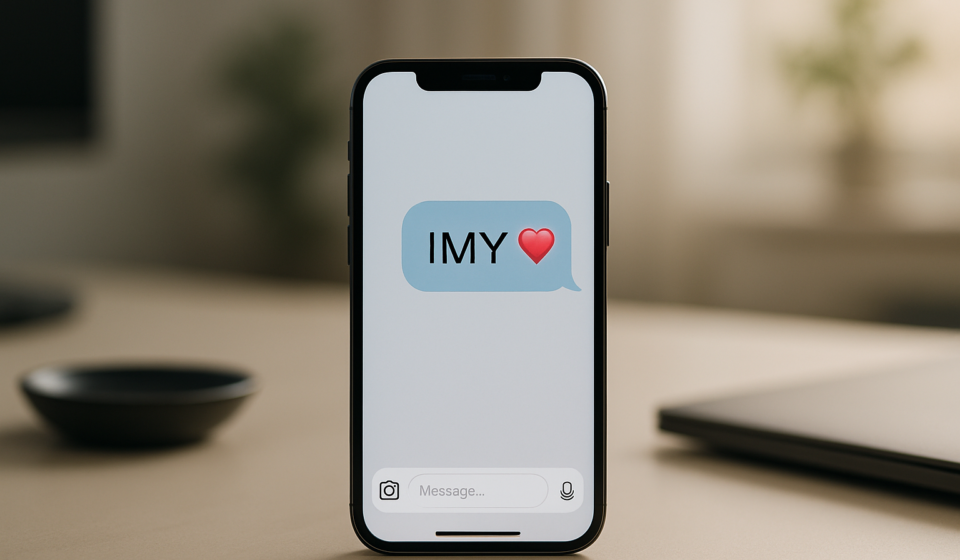
At its core, IMY is a straightforward abbreviation that has gained widespread usage in text messages, social media platforms, and other digital communication channels.
IMY stands for ‘I Miss You.’
This three-letter acronym efficiently condenses a powerful emotional sentiment into a quick text. The abbreviation emerged alongside other popular text shortcuts like LOL (laugh out loud), BRB (be right back), and OMG (oh my god) during the rise of SMS messaging when character limits and typing efficiency were paramount concerns.
In 2025, despite the evolution of messaging platforms and the removal of many technical constraints, IMY remains popular because it captures an intimate sentiment in a casual, low-pressure format. The abbreviation offers a way to express feelings of longing without the perceived intensity or vulnerability that might come with typing out the full phrase.
The Emotional Weight Behind ‘IMY’
While IMY may seem like a simple abbreviation, its emotional implications vary widely depending on the context and relationship between the sender and recipient. Understanding these nuances can help you interpret the message’s true intent and respond appropriately.
| Tone | Example | Implication |
|---|---|---|
| Casual | “Haven’t seen you at game night lately. IMY! 🎮” | A friendly acknowledgment of someone’s absence without deep emotional undertones |
| Emotional | “These past few weeks have been so hard. IMY so much. 💔” | Expresses genuine emotional longing and perhaps vulnerability |
| Romantic | “Counting down the days until I see you again. IMY every second. ❤️” | Clear romantic connotation suggesting deep attachment and desire |
| Formal | “Your contributions to the team have been valuable. Your expertise is missed during this project phase.” | Note: The full “I miss you” or more professional alternatives would typically be used instead of IMY in formal contexts |
The emotional weight of IMY is also influenced by factors like frequency of use, accompanying emojis, and the overall communication pattern between individuals. A first-time “IMY” might carry more significance than its regular use in established relationships where it’s become part of normal communication.
When to Use or Respond to ‘IMY’
Knowing when to deploy this abbreviation—and when to avoid it—can help maintain healthy communication boundaries and ensure your message is received as intended.
Suitable Scenarios:
- Long-distance relationships – When physical separation makes expressing longing appropriate
- After meaningful time spent together – Following vacations, visits, or significant shared experiences
- During extended absences – When normal communication patterns are disrupted due to work, travel, or other circumstances
- In established relationships – Where mutual feelings have been previously acknowledged
- As comfort during difficult times – When someone might need emotional reassurance
- When resuming contact after a communication lapse – To warmly reestablish connection
Scenarios to Avoid:
- Very new relationships – Before emotional investment is mutually established
- Professional contexts – Work communications generally require more formal language
- After conflict or during “cooling off” periods – Could be perceived as emotional manipulation
- Repeatedly in short timeframes – May come across as clingy or create pressure
- When the recipient has set boundaries – Respect their communication preferences
- One-sided relationships – When interest or investment is noticeably unbalanced
In 2025’s digital landscape, understanding the social context before sending emotionally charged messages like IMY demonstrates digital emotional intelligence—an increasingly valued social skill.
Alternatives to ‘IMY’: Tone-Appropriate Variations
Sometimes “IMY” doesn’t quite capture the nuance you want to express. Here are thoughtful alternatives that can convey similar sentiments with different emotional tones:
1. ‘I’ve been thinking about you.’
This phrase communicates that someone has been on your mind without explicitly stating longing. It’s less emotionally charged than IMY while still showing care and connection.
2. ‘Can’t wait to see you again!’
Forward-looking and positive, this alternative focuses on anticipation rather than absence, making it ideal for situations where you’ll be reunited soon.
3. ‘It feels like forever since we talked.’
This subtly communicates that you’ve noticed their absence without directly expressing emotional need, making it suitable for rekindling conversations with casual connections.
4. ‘Missing our chats/laughs/times together.’
By specifying what exactly you miss, this alternative adds authenticity and personalization to your expression of longing.
5. ‘Wish you were here.’
This classic expression works particularly well when experiencing something the other person would enjoy, creating a sense of shared experience despite distance.
6. ‘Your presence is definitely missed.’
Slightly more formal than IMY, this phrasing can work in semi-professional relationships or with acquaintances where direct emotional language might feel too intimate.
7. ‘Feeling your absence lately.’
This poetic alternative conveys emotional depth without being overly direct, suitable for more nuanced emotional expression.
8. ‘Every little thing reminds me of you.’
Romantic and evocative, this alternative works well for intimate relationships where deeper emotional expression is appropriate. bb’s romantic interpretations in texting can further enhance the emotional connection between partners. By using playful language and thoughtful emojis, couples can convey sentiments that words alone may not fully capture. This approach encourages a more profound exchange of feelings, allowing love to flourish in the digital realm.
9. ‘Let’s not go this long without talking again.’
This forward-looking statement acknowledges the separation while suggesting a positive change for the future.
10. ‘You’ve been on my mind a lot.’
Similar to “I’ve been thinking about you,” but the addition of “a lot” implies more frequency and significance.
11. ‘I really value our time together.’
This expresses appreciation rather than longing, making it appropriate for various relationship types, including professional mentorships or friendships.
12. ‘Our last conversation meant a lot to me.’
By referencing a specific interaction, this alternative feels more substantial and thoughtful than a generic expression of missing someone.
13. ‘The distance makes me appreciate you even more.’
This positive spin on separation acknowledges the challenge while focusing on the strengthening of connection rather than just the pain of absence.
Nuances of Tone: Choosing the Right Way to Say ‘I Miss You’
The way you express missing someone should align with the nature of your relationship and the emotional context you want to establish. Here’s how to match your expression to different relationship dynamics:
Casual / Friendly
For platonic friends, acquaintances, or relationships where you want to maintain light emotional investment, casual expressions work best. Using IMY with emojis like 😎 or 👋 can keep the tone friendly. Phrases like “We should catch up soon!” or “The group’s not the same without you” communicate fondness without intensity.
In 2025, casual digital communication often incorporates memes, GIFs, or references to shared interests alongside expressions like IMY to maintain lightheartedness while still acknowledging connection.
Emotional / Intimate
For close relationships where emotional vulnerability is established, IMY can be enhanced with modifiers like “so much,” “terribly,” or “more than words can say.” Emojis like ❤️, 😢, or 🥺 signal deeper emotional investment.
Digital intimacy in 2025 often incorporates voice notes or short video messages alongside text-based expressions, allowing for greater emotional nuance when saying “I miss you.” These multimedia elements can convey tone of voice, facial expressions, and environmental context that text alone cannot capture.
Professional / Formal
In work relationships, the abbreviation IMY is rarely appropriate. Instead, professional alternatives focus on the practical impact of someone’s absence: “Your expertise would be valuable for this project” or “We look forward to having you back on the team.”
In 2025’s hybrid work environments, acknowledging a colleague’s valuable contributions while respecting professional boundaries has become an important social skill, especially as remote and in-person work dynamics continue to evolve.
How to Respond to ‘IMY’ Gracefully (13 Examples)
Receiving an “IMY” text can sometimes leave you searching for the right response. Here are thoughtful ways to reply based on your feelings and the relationship context:
- “IMY too! Can’t wait to catch up soon.” – A straightforward reciprocation that works in most relationships when you genuinely share the sentiment.
- “It’s been too long! Let’s fix that with [specific plan].” – Acknowledges the sentiment and proactively suggests reconnection, moving the conversation toward concrete plans.
- “Things haven’t been the same without you here.” – A warm acknowledgment that validates their importance without directly saying “I miss you too” if that feels too intense.
- “I was just thinking about you today!” – A positive response that maintains connection without necessarily matching their emotional intensity if you’re not there yet.
- “That means a lot to hear. I’ve been missing our [specific activity] too.” – Acknowledges their sentiment while personalizing your response, making it feel genuine.
- “The feeling is definitely mutual. How have you been?” – Reciprocates and smoothly transitions to continued conversation, showing interest in their current life.
- “❤️ [or other appropriate emoji]” – Sometimes a simple emoji acknowledgment works when words feel unnecessary or when you want to keep things light.
- “Distance makes the heart grow fonder, doesn’t it? Miss you lots.” – A slightly playful response that acknowledges the sentiment while adding a touch of wisdom or perspective.
- “Thanks for thinking of me. Life’s been crazy but you’re often on my mind too.” – Appreciative and honest, especially when busy schedules have kept you from reaching out first.
- “IMY more! When can we ?” – Playfully competitive while steering toward action, good for close relationships with established patterns.
- “It’s only been [time period] but somehow it feels longer!” – Acknowledges the emotional weight of separation even when the actual time apart has been relatively short.
- “I’ve been keeping busy with [activity] but there’s definitely a [name]-shaped hole in my days.” – Honest and personalized, sharing what you’ve been doing while acknowledging their absence.
- “Your message just brightened my entire day.” – Focuses on the positive impact of their reaching out rather than directly addressing the missing, suitable when you’re navigating complex feelings.
The best response to IMY is one that feels authentic to your feelings while respecting the relationship’s current boundaries. In 2025’s digital communication landscape, authenticity is increasingly valued over performative responses, even if that means not perfectly mirroring the other person’s emotional tone.
Final Thoughts: Mastering Textual Affection with IMY
As we navigate relationships in 2025’s digital-first world, understanding the nuances of expressions like IMY has become an essential social skill. The three-letter abbreviation for “I miss you” carries emotional weight that varies widely based on context, relationship dynamics, and individual communication styles.
The most effective use of IMY in text comes from alignment with your true feelings and appropriate matching to your relationship with the recipient. Whether you’re using this abbreviation, responding to it, or choosing one of the many alternatives we’ve explored, authenticity remains the key to meaningful digital connection.
Digital communication continues to evolve, but the human need for expression of care, longing, and connection remains constant. By thoughtfully deploying expressions of missing someone—whether through abbreviations like IMY or more elaborate expressions—we maintain emotional bonds across physical distance and busy schedules.
As texting slang in 2025 continues to develop, emotional intelligence in digital spaces becomes increasingly valuable. Understanding not just the literal meaning of abbreviations like IMY but their emotional implications demonstrates a sophistication in communication that enhances all your relationships—romantic, friendly, and professional.
Remember that behind every text exchange is a human connection, and expressions of missing someone, however abbreviated, are fundamentally about maintaining those meaningful bonds that enrich our lives.