

In today’s fast-paced digital communication landscape, acronyms and shorthand expressions have become essential tools for efficient interaction. Among these, ‘LMK’ stands out as a versatile and widely used acronym that has found its way into both casual conversations and professional exchanges. Understanding when and how to use this expression—and when to opt for alternatives—can significantly enhance your communication effectiveness. similarly, understanding hyd in modern texting is crucial as it helps clarify intentions and fosters clearer dialogues. Many users may find themselves confused by this acronym, yet grasping its meaning can facilitate more engaging conversations. As language evolves in digital spaces, staying informed about such terms is key to maintaining effective communication.
Table Of Content
- What Does ‘LMK’ Stand For?
- Is ‘LMK’ Formal or Informal?
- Tone Nuance: Why Alternatives to ‘LMK’ Matter
- 13 Powerful Alternatives to ‘LMK’ Based on Tone & Context
- 1. Please advise
- 2. I’d appreciate your feedback
- 3. Please confirm
- 4. I await your response
- 5. Your thoughts?
- 6. Do let me know
- 7. I’d like to hear your decision on this
- 8. Keep me posted
- 9. I need your input by [time/date]
- 10. Please share your perspective
- 11. What are your thoughts on this?
- 12. I’d value your opinion
- 13. Kindly inform me
- How to Choose the Best Alternative to ‘LMK’ (Cheat Sheet Table)
- When You Should Still Use ‘LMK’
- LMK in Workplace Tools (Slack/Teams)
- Common Mistakes to Avoid When Using ‘LMK’
- Final Takeaway: ‘LMK’ Is Useful, But Not Universal
What Does ‘LMK’ Stand For?
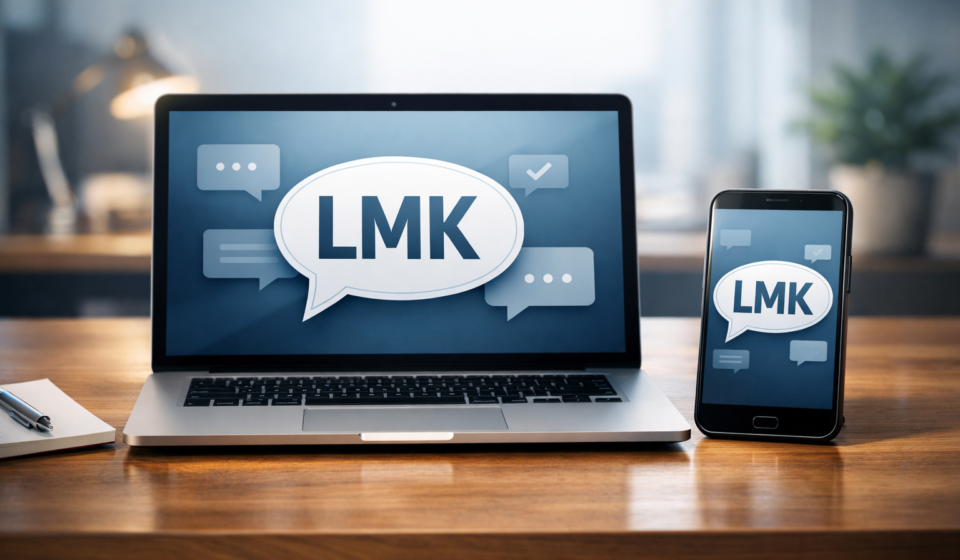
‘LMK’ is an acronym that stands for “Let Me Know.” This three-letter abbreviation has become a staple in text messages, emails, social media, and various digital communication platforms. It serves as a concise way to request information, feedback, or a response from the recipient.
The beauty of ‘LMK’ lies in its simplicity and efficiency. Instead of writing out the full phrase “let me know,” users can convey the same message with just three letters, making communication quicker and more streamlined.
Common usage examples include:
- “I’m thinking about ordering pizza for dinner. LMK if you want some.”
- “I’ve sent the proposal to the client. LMK when you hear back from them.”
- “The meeting might be rescheduled. LMK if you’re available tomorrow instead.”
Is ‘LMK’ Formal or Informal?
Understanding the appropriate contexts for using ‘LMK’ is crucial for effective communication. The formality level of this acronym varies depending on the relationship between communicators and the communication medium.
| Context | Formality Level | Appropriateness |
|---|---|---|
| Texting friends | Informal | Highly appropriate |
| Social media comments | Informal | Appropriate |
| Team chat (Slack, Teams) | Semi-formal | Usually appropriate |
| Work emails to peers | Semi-formal | Context-dependent |
| Client communications | Formal | Generally inappropriate |
| Executive communications | Formal | Inappropriate |
As a general rule, ‘LMK’ is primarily considered informal text slang that originated in casual digital conversations. However, its acceptance in professional settings has grown as workplace communication has become more relaxed and digital-centric, especially in tech companies and startups with casual corporate cultures.
Tone Nuance: Why Alternatives to ‘LMK’ Matter
While ‘LMK’ is convenient and widely recognized, its tone can sometimes miss the mark in professional or nuanced communications. The acronym carries certain limitations:
- Potential perception of casualness: In formal contexts, it might be perceived as too relaxed or unprofessional.
- Lack of urgency differentiation: ‘LMK’ doesn’t inherently convey whether feedback is needed urgently or at the recipient’s leisure.
- Absence of relationship nuance: The same ‘LMK’ used with a friend may feel too familiar when used with a superior.
- Missing contextual clarity: It doesn’t specify the type of response desired (approval, opinion, decision, etc.).
Understanding these limitations helps communicators choose more appropriate alternatives when the situation calls for greater precision, formality, or clarity.
13 Powerful Alternatives to ‘LMK’ Based on Tone & Context
Depending on your specific communication needs, here are 13 effective alternatives to ‘LMK’ that offer different tones and levels of formality:
1. Please advise
Tone: Formal, professional
Example: “We have two options for the project timeline. Please advise on your preference.”
Best For: Client communications, emails to superiors, formal business contexts
2. I’d appreciate your feedback
Tone: Polite, respectful
Example: “I’ve drafted the proposal. I’d appreciate your feedback before finalizing it.”
Best For: Professional peer communications, situations requiring thoughtful input
3. Please confirm
Tone: Direct, action-oriented
Example: “The meeting is scheduled for 3 PM tomorrow. Please confirm your attendance.”
Best For: When a simple confirmation is needed, logistics planning
4. I await your response
Tone: Formal, slightly urgent
Example: “The proposal requires your approval by Friday. I await your response.”
Best For: Formal requests with time sensitivity
5. Your thoughts?
Tone: Casual, inviting
Example: “I’ve reworked the presentation based on yesterday’s feedback. Your thoughts?”
Best For: Collaborative environments, brainstorming contexts
6. Do let me know
Tone: Polite, slightly formal
Example: “Do let me know if you’d prefer to discuss this in person rather than via email.”
Best For: Semi-formal communications with a touch of politeness
7. I’d like to hear your decision on this
Tone: Formal, expectant
Example: “I’ve presented both options with their pros and cons. I’d like to hear your decision on this.”
Best For: When a definitive answer or decision is required
8. Keep me posted
Tone: Casual, ongoing
Example: “Keep me posted on how the client meeting goes tomorrow.”
Best For: Situations requiring continued updates rather than a single response
9. I need your input by [time/date]
Tone: Direct, deadline-oriented
Example: “I need your input on the budget allocations by Wednesday noon.”
Best For: Time-sensitive requests with clear deadlines
10. Please share your perspective
Tone: Respectful, valuing opinion
Example: “As someone with experience in this area, please share your perspective on this approach.”
Best For: When seeking thoughtful, experience-based input
11. What are your thoughts on this?
Tone: Open-ended, conversational
Example: “I’ve drafted a new content strategy. What are your thoughts on this?”
Best For: When seeking comprehensive feedback rather than a simple yes/no
12. I’d value your opinion
Tone: Respectful, esteeming
Example: “Before finalizing, I’d value your opinion on which design better meets our objectives.”
Best For: When genuinely seeking input from someone whose view you respect
13. Kindly inform me
Tone: Formal, polite
Example: “Kindly inform me of your availability for the upcoming conference.”
Best For: Formal emails, especially in international business contexts
How to Choose the Best Alternative to ‘LMK’ (Cheat Sheet Table)
| If You Need | Use This Alternative | Avoid |
|---|---|---|
| Formal response from superiors | “Please advise” or “I await your guidance” | “LMK” or “Your thoughts?” |
| Quick confirmation | “Please confirm” or “A quick confirmation would be helpful” | “I’d appreciate your detailed feedback” |
| Thoughtful feedback | “I’d value your perspective” or “Please share your insights” | “Let me know yes/no” |
| Urgent response | “I need your input by [specific time]” or “Urgent feedback required” | “Keep me posted” or “LMK when you can” |
| Ongoing updates | “Keep me posted” or “Please update me as this progresses” | “Please confirm” or “I need your decision” |
When You Should Still Use ‘LMK’
Despite its limitations, ‘LMK’ remains perfectly appropriate and even preferable in many contexts:
- Casual conversations with friends, family, and close colleagues
- Informal team chats in workplaces with relaxed communication cultures
- Space-constrained platforms like Twitter where character count matters
- Quick follow-ups in ongoing conversations where formality has already been established
- Situations requiring brevity over formality (e.g., quick coordination messages)
Quick Rule: When in doubt about using ‘LMK,’ consider: Would I use other acronyms like ‘BTW’ or ‘FYI’ in this same conversation? If yes, ‘LMK’ is likely appropriate. If no, choose a more formal alternative.
LMK in Workplace Tools (Slack/Teams)
Modern workplace communication tools like Slack and Microsoft Teams have created a new context for expressions like ‘LMK.’ These platforms often occupy a middle ground between formal emails and casual texting.
In these environments, ‘LMK’ is generally more acceptable than in formal emails but should still be used with attention to your organizational culture. Consider these guidelines:
- Team-specific channels: Usually appropriate for ‘LMK’
- Cross-departmental channels: Use with more discretion
- Channels including executives: Better to use more formal alternatives
- Direct messages to peers: Generally appropriate
- Direct messages to superiors: Depends on your established rapport
Common Mistakes to Avoid When Using ‘LMK’
Even when using ‘LMK’ in appropriate contexts, certain mistakes can undermine your communication effectiveness:
- Vague requests: “I made some changes. LMK.” (Better: “I updated the pricing section. LMK if you approve.”)
- Lack of timeline: “LMK what you think.” (Better: “LMK your thoughts by tomorrow noon.”)
- Using with unfamiliar contacts: Avoid with new clients or senior executives until communication style is established
- Adding too many acronyms: “ICYMI, the doc is ready. LMK ASAP if it’s OK.” (Creates potential confusion)
- Omitting context: “LMK” as a standalone message without specifying what you need to know
Final Takeaway: ‘LMK’ Is Useful, But Not Universal
‘LMK’ represents the evolution of language in the digital age—a helpful shorthand that streamlines communication in many contexts. However, like all linguistic tools, its effectiveness depends entirely on using it in appropriate situations with the right audience.
The most effective communicators understand when ‘LMK’ serves their purpose perfectly and when a more nuanced alternative better conveys their intent, urgency, or relationship with the recipient. By developing this awareness, you can leverage both the convenience of modern text slang and the precision of more traditional expressions.
As digital communication continues to evolve, staying attuned to these subtleties will serve you well across personal and professional interactions. Whether you choose ‘LMK’ or one of its many alternatives, the key is making your choice deliberately based on context, audience, and desired response.