

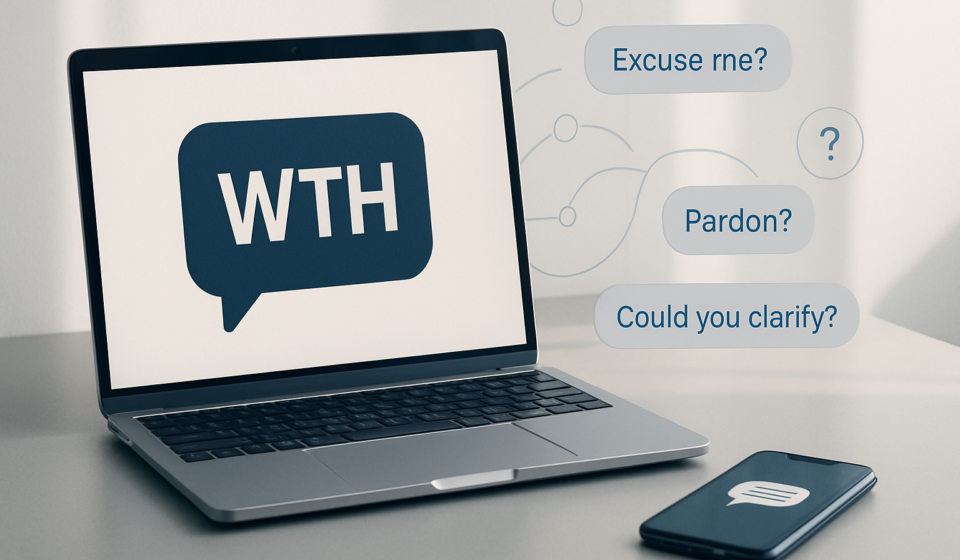
Understanding WTH in Digital Communication
In our increasingly digital world, acronyms and shorthand expressions have become the lingua franca of text messaging, social media, and even workplace communication. Among these acronyms, ‘WTH’ has emerged as a common expression of surprise, confusion, or disbelief. But what exactly does it mean, when is it appropriate to use, and how can we express the same sentiment more professionally when needed?
Table Of Content
- Understanding WTH in Digital Communication
- What WTH Actually Stands For
- Is WTH Considered Rude or Offensive?
- When to Use WTH—and When Not To
- Okay to Use WTH When
- Avoid WTH When
- Tone Matters: How WTH Comes Across
- Why You Might Want Alternatives to ‘WTH’
- 15 Polite, Casual, or Professional Alternatives to ‘WTH’
- How to Choose the Right Alternative Based on Context
- Consider Your Audience
- Evaluate Your Tone
- Consider the Platform
- Examples of WTH and Its Alternatives in Real-Life Context
- Scenario 1: Text Message with a Friend
- Scenario 2: Work Chat with Colleagues
- Scenario 3: Customer Service Interaction
- Scenario 4: Social Media Comment
- Scenario 5: Email to a Superior
- Final Thoughts: Using WTH Wisely in 2025 and Beyond
As we navigate digital communication in 2026, understanding the nuances of these expressions becomes increasingly important for maintaining professionalism while still communicating authentically in casual contexts. This comprehensive guide unpacks everything you need to know about WTH and provides thoughtful alternatives for various communication scenarios.
What WTH Actually Stands For
The acronym ‘WTH’ primarily stands for ‘What The Heck‘ or ‘What The Hell,’ depending on the user’s intended emphasis and comfort with stronger language. It’s an expression typically used to convey:
- Surprise: A reaction to unexpected news or developments
- Disbelief: Questioning the reality or validity of information
- Confusion: Expressing a lack of understanding
- Frustration: Communicating annoyance at a situation
While ‘What The Heck’ is considered the milder version, both variations carry similar emotional weight in digital conversation. The acronym emerged as a way to quickly express these emotions in text without typing out the full phrase, following the pattern of other popular acronyms like LOL, OMG, and SMH.
In some cases, users might also interpret WTH as ‘What The Heck’ in more professional or family-friendly contexts, deliberately choosing the softer interpretation to avoid potential offense.
Is WTH Considered Rude or Offensive?
The perceived rudeness or appropriateness of ‘WTH’ largely depends on the context in which it’s used. Understanding these contextual nuances is critical for effective communication.
In casual contexts among friends, family members, or close colleagues who communicate informally, WTH is generally considered:
- Acceptable and commonplace
- A natural expression of surprise or disbelief
- No more offensive than saying the full phrase would be
However, in professional contexts, WTH may be perceived as:
- Too casual or unprofessional
- Potentially disrespectful, especially when communicating with superiors
- Inappropriate for client communication or formal business correspondence
- Unnecessarily emotional or reactive in a workplace setting
The level of offense also varies based on generational and cultural factors. Younger generations who grew up with texting culture may find WTH completely innocuous, while older generations or more traditional professional environments might consider it inappropriate regardless of the intended meaning.
When to Use WTH—and When Not To
Okay to Use WTH When
There are several situations where using WTH is generally acceptable:
- Personal text messages with friends and family
- Casual social media posts and comments among peers
- Informal group chats with colleagues you have a friendly rapport with
- Reaction to truly surprising news in contexts where mild expressions of shock are acceptable
- Gaming or entertainment communities where casual language is the norm
In these scenarios, WTH serves as an efficient way to express genuine surprise or confusion without causing offense or seeming unprofessional.
Avoid WTH When
There are several contexts where it’s best to avoid using WTH:
- Formal business emails or correspondence
- Communication with clients or potential business partners
- Professional documents of any kind
- Messages to superiors or people you don’t know well
- Public-facing customer service interactions
- Job applications or professional networking messages
- Educational settings when communicating with instructors
In these professional contexts, even the milder interpretation of WTH can come across as too casual, potentially emotional, or simply unprofessional.
Tone Matters: How WTH Comes Across
The perceived tone of WTH can vary significantly depending on the context, accompanying message, and relationship between communicators. Understanding these tonal variations can help you decide when—and how—to use this expression.
| Tone | Description | Example Usage |
|---|---|---|
| Shocked | Genuine surprise at unexpected information | “WTH! Did you see they’re closing our favorite coffee shop?” |
| Annoyed | Frustration or irritation at a situation | “WTH is happening with this app? It keeps crashing.” |
| Confused | Inability to understand or make sense of something | “WTH does this error message even mean?” |
| Amused | Lighthearted reaction to something absurd | “WTH 😂 That cat video is the weirdest thing I’ve seen all day!” |
| Indignant | Offended or outraged response | “WTH! They charged me twice for the same order!” |
| Dismissive | Rejection of an idea or suggestion | “WTH are you talking about? That would never work.” |
The emotional intensity conveyed by WTH is important to consider. In writing, without facial expressions or tone of voice, acronyms like WTH can sometimes come across more intensely than intended. Adding context, emojis, or additional explanation can help clarify your intended tone.
Why You Might Want Alternatives to ‘WTH’
There are several compelling reasons to expand your expressive vocabulary beyond WTH:
- Professional perception: Using slang or acronyms in professional settings can undermine your credibility and professionalism
- Clarity of communication: Not everyone (particularly across generations) recognizes or interprets digital acronyms the same way
- Emotional precision: Alternative phrases can more accurately convey specific emotions like mild surprise versus genuine shock
- Avoiding misinterpretation: WTH can be perceived as more aggressive or negative than intended
- Cultural sensitivity: In some cultural or professional contexts, even implied profanity can be problematic
Having a range of alternatives at your disposal allows you to express the same sentiment while adjusting for the appropriate level of formality, emotional intensity, and professionalism required by different situations.
15 Polite, Casual, or Professional Alternatives to ‘WTH’
- “What on earth?” – A classic, polite expression of surprise suitable for most contexts
Example: “What on earth happened to the website? It looks completely different!” - “I’m confused.” – A straightforward, professional way to express bewilderment
Example: “I’m confused about the process change. Could you clarify?” - “Wait, what?” – Casual but not crude, perfect for expressing surprise in friendly contexts
Example: “Wait, what? You’re moving to Paris next month?” - “I’m surprised to see/hear this.” – Professional and measured for workplace communication
Example: “I’m surprised to see these figures differ so significantly from our projections.” - “This is unexpected.” – Neutral and professional for business contexts
Example: “This is unexpected. We’ll need to reconsider our approach.” - “I don’t understand.” – Clear, direct, and appropriate for all contexts
Example: “I don’t understand why the deadline changed without notification.” - “That’s surprising.” – Simple and effective for professional settings
Example: “That’s surprising. The market usually behaves differently under these conditions.” - “Could you clarify?” – Shifts focus to seeking understanding rather than expressing shock
Example: “Could you clarify why this decision was made?” - “I’m taken aback.” – More formal expression of surprise for professional settings
Example: “I’m taken aback by the committee’s decision.” - “Seriously?” – Casual but less potentially offensive than WTH
Example: “Seriously? They canceled the entire project?” - “This is concerning.” – Professional way to express worry about a situation
Example: “This is concerning. The numbers don’t align with our expectations.” - “I’m baffled.” – Expresses confusion in a more sophisticated way
Example: “I’m baffled by the logic behind this approach.” - “That’s startling.” – Conveys surprise with a touch of formality
Example: “That’s startling news about the merger.” - “How did this happen?” – Focuses on seeking information rather than just expressing shock
Example: “How did this happen to our carefully tested system?” - “I’m at a loss.” – Expresses confusion or disbelief in a professional manner
Example: “I’m at a loss to understand how these errors weren’t caught sooner.”
How to Choose the Right Alternative Based on Context
Selecting the most appropriate alternative to WTH depends on several key factors:
Consider Your Audience
- Professional superiors: Choose the most formal alternatives (“I’m surprised to see” or “This is unexpected”)
- Colleagues: Moderately formal to casual depending on your relationship (“That’s surprising” or “Wait, what?”)
- Friends and family: Casual alternatives are usually fine (“Seriously?” or “What on earth?”)
- Age and generational factors: Older or more traditional audiences may appreciate more formal language
Evaluate Your Tone
- For genuine confusion: “I don’t understand” or “Could you clarify?”
- For surprise without negativity: “That’s surprising” or “I didn’t expect that”
- For concerned surprise: “This is concerning” or “I’m taken aback”
- For lighthearted surprise: “Wait, what?” or “Seriously?”
Consider the Platform
- Email: More formal alternatives are typically appropriate
- Work messaging platforms: Slightly more casual but still professional
- Social media: Platform-dependent, but generally more casual is acceptable
- Text messages: Usually the most casual, though still context-dependent
The key is to match the level of formality and emotional intensity to both the situation and your relationship with the recipient. When in doubt, err on the side of more professional language, especially in work contexts.
Examples of WTH and Its Alternatives in Real-Life Context
To better understand how WTH and its alternatives work in practice, let’s examine some real-world scenarios:
Scenario 1: Text Message with a Friend
Using WTH: “WTH! Did you see Chris quit his job to become a professional surfer?”
Alternative: “Whoa, seriously?! Did you see Chris quit his job to become a professional surfer?”
Analysis: Both are appropriate in this casual context, but the alternative avoids even mild implied profanity while conveying the same surprise.
Scenario 2: Work Chat with Colleagues
Using WTH: “WTH? The client completely changed the project requirements again!”
Alternative: “This is surprising. The client completely changed the project requirements again. How should we proceed?”
Analysis: The alternative maintains professionalism while still conveying concern, and adds a constructive question to move the conversation forward.
Scenario 3: Customer Service Interaction
Using WTH: “WTH is happening with my order? It’s been three weeks!”
Alternative: “I’m concerned about my order status. It’s been three weeks with no updates. Could you please check on this?”
Analysis: The alternative expresses the same concern but in a way that’s more likely to receive helpful service rather than defensive responses.
Scenario 4: Social Media Comment
Using WTH: “WTH is with these new privacy policies? Nobody asked for this!”
Alternative: “These new privacy policies are concerning. I’m curious if others feel the same way?”
Analysis: The alternative opens up discussion rather than just expressing frustration, and avoids potential policy violations on platforms with language restrictions.
Scenario 5: Email to a Superior
Using WTH: “WTH happened to our budget approval? We were supposed to get it last week.”
Alternative: “I wanted to inquire about the status of our budget approval, as we were expecting it last week. Has there been a delay we should be aware of?”
Analysis: The alternative is significantly more professional and respectful while still addressing the concern.
Final Thoughts: Using WTH Wisely in 2025 and Beyond
As digital communication continues to evolve in 2025, the boundaries between formal and casual expression continue to shift. While acronyms like WTH have become commonplace in many contexts, understanding when and how to use them—or when to opt for alternatives—remains an important social and professional skill.
Remember these key takeaways:
- Context matters tremendously when deciding whether WTH is appropriate
- The perceived meaning and intensity of WTH can vary based on audience, generation, and culture
- Having a repertoire of alternatives allows you to express surprise or confusion appropriately across different situations
- In professional contexts, erring on the side of formality is usually the safer choice
- Digital communication norms continue to evolve, but professionalism remains valued in workplace contexts
By expanding your expressive vocabulary beyond acronyms like WTH, you demonstrate communication flexibility and awareness—valuable skills in both personal and professional relationships. Whether you choose to use WTH in casual contexts or opt for alternatives in professional settings, being intentional about your digital communication choices will serve you well in our increasingly text-based world.
As we move forward in our digital communication landscape, remember that the goal is always clear, effective communication that conveys your intended meaning while respecting both the context and your audience.